
Daily Horoscope 2026
PDF, AI, Tools, Utilities, Useful Apps by MolibeLifestyle
4.6584.00 Reviews
- Version
- 2.0.13
- Installs
- 500.00K
- Age Rating
- Everyone
Screenshots
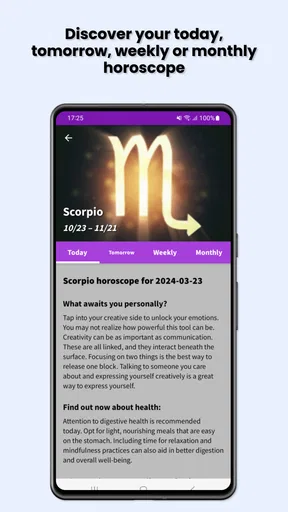
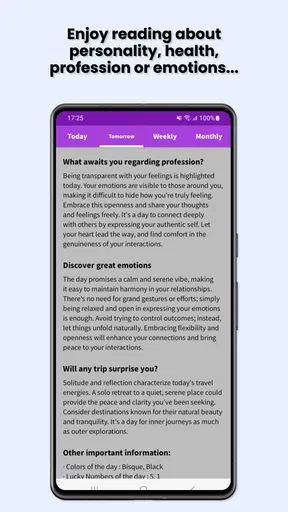
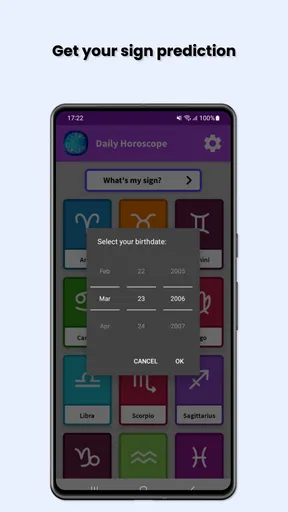
Our Review of Daily Horoscope 2026
 Analysis by Appyee
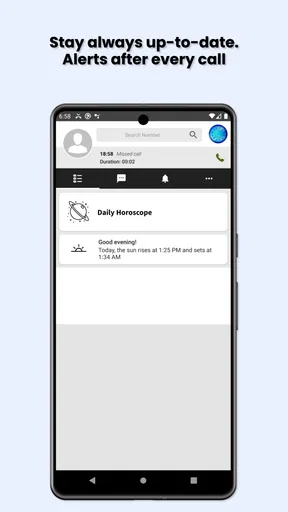
I tried Daily Horoscope 2026 as a casual astrology app rather than as a serious decision-making tool, and that distinction matters. It is a free lifestyle app from PDF, AI, Tools, Utilities, Useful Apps by Molibe, built around daily horoscope reading and a particularly noticeable idea: showing astrology content after calls. That makes it feel less like an app I open for a long session and more like a small routine that can appear during an ordinary day.
My first impression was that it is aimed at people who enjoy checking a horoscope without wanting to study astrology in depth. You do not need to know birth charts, planetary terminology, or complicated symbolism to get value from it. The appeal is the quick moment of reflection: read a short prediction, think about how it relates to your day, and move on. If you want a full astrology workspace with detailed charts and deep interpretation, this will probably feel limited. If you want a lightweight daily habit, it is much easier to approach.
How it works in a shared household
The most interesting way to use this app is not necessarily alone. In a household where several people share a tablet or occasionally use the same phone, a horoscope app can become a small conversation starter. One person may check the reading in the morning, another may look later, and both can compare how the wording feels against their own plans. That works best when everyone treats the content as entertainment or personal reflection rather than as an instruction.
I would not treat a shared device as a single astrology identity. Horoscope content is personal by nature, so a family member opening the app after someone else has used it may see a context that does not belong to them. The practical solution is simple: each person should make it clear when they are using the app, and nobody should assume that a displayed reading represents the whole household. This is especially important when a child, parent, or partner borrows the phone and encounters a screen intended for someone else.
A realistic example would be a couple getting ready for work. One person checks the day’s reading while waiting for coffee, then mentions an encouraging line to the other. Later, the second person looks at the app independently and decides whether the message feels relevant. That is a pleasant shared ritual because it creates conversation without requiring identical beliefs. It becomes less useful when one person starts using the horoscope to pressure another into changing plans.
The after-call behavior also changes the rhythm of shared use. On a personal phone, it can turn the end of a conversation into a prompt to pause and read something brief. On a shared device, that same timing may confuse the next user, who could reasonably wonder why the content appeared. I recommend explaining the app’s purpose to anyone who regularly borrows the phone instead of assuming they will understand the context.
Keep the first setup personal
When I install an app like this, I prefer to decide immediately who it is for and where it will be used. That is more important here than it might seem, because the app belongs to the lifestyle category and is designed around a personal daily experience, not a household dashboard. I would avoid presenting it as a communal source of guidance. It is better described as an individual reading that can be discussed with others.
If several people want to use it, a shared phone is workable for casual checking, but it requires a little discipline. The person who owns the device should be the one to manage the installation and review the available settings. Other household members should know that the app is free to install, while optional in-app purchases range from around four dollars to around sixteen dollars per item. That conversation prevents an accidental purchase from becoming a surprise later.
The purchase point is one of the few areas where household boundaries matter more than the app’s simple concept suggests. A child tapping through an astrology app may see an attractive option without understanding that it costs real money. I would not hand over a shared device without first discussing who can approve purchases. The app’s free entry point is convenient, but “free” does not mean every part of the experience is necessarily included at no cost.
There is also a useful distinction between an app being easy to access and an app being suitable for every person in the home. Daily Horoscope 2026 carries an Everyone content rating, so it is broadly approachable from an age perspective. Still, I would explain to younger users that horoscope text is not a substitute for advice from a parent, teacher, doctor, or other trusted adult. The rating describes general content suitability; it does not decide how a family should interpret predictions.
Coordination without pretending it is a family tool
One limitation I noticed in thinking about household use is that this is not a coordination platform. I would not choose it to organize chores, appointments, school activities, or family decisions. Its role is much narrower: it offers a personal astrology moment that can be shared socially if everyone understands what it is. That narrow role is a strength when you want simplicity, but a weakness if you expect profiles, calendars, shared notes, or a family view.
For a household routine, I would pair it with an ordinary calendar or messaging app rather than trying to make the horoscope do practical work. For example, a family could read their individual predictions in the morning, then use a separate shared calendar to manage the actual day. This keeps the emotional or reflective part separate from commitments that need clear, factual coordination.
That separation is also useful when horoscope wording feels vague or surprisingly accurate. A family member may enjoy discussing it, while another may not believe in astrology at all. The app works best when both reactions are acceptable. I found that its value depends less on whether every prediction comes true and more on whether the reading gives me a prompt to consider my mood, priorities, or communication with other people.
For a shared device, I would establish a simple rule: the app can inspire conversation, but it cannot settle an argument. That may sound obvious, yet it is the difference between a harmless daily ritual and an uncomfortable source of authority. If someone says a horoscope proves that another person should cancel a plan, I would treat that as a sign to step back rather than as a feature of the app.
What the daily routine feels like
The strongest use case is a short check-in. I can imagine opening it while commuting, during a quiet breakfast, or after finishing a call. The format suits people who want a little atmosphere without committing to a lengthy reading. The store summary positions it as something that goes beyond a standard daily horoscope, and the post-call concept gives it a distinct place in the day compared with an app that only waits for a manual launch.
That convenience can also become friction. A prompt arriving at the wrong moment may feel intrusive, especially when I am moving between work tasks or trying to keep my phone quiet. I would be selective about where I allow the app to fit into my routine. If the after-call experience interrupts concentration, the app loses much of its charm. A horoscope is optional by nature, so it should remain easy to ignore when the timing is bad.
My practical tip is to use the reading as a question rather than a forecast. Instead of asking, “Will this definitely happen?”, I would ask, “Is there something here I should think about today?” That approach makes the content more useful and reduces the disappointment that comes from expecting precise predictions. It also makes the app easier to share with skeptical relatives, because nobody has to pretend that the text is a factual schedule.
Another useful habit is to avoid checking the app repeatedly whenever a day feels uncertain. Frequent refreshing can turn a light lifestyle activity into reassurance-seeking. I prefer one deliberate reading, followed by real-world action based on evidence and conversation. That is a small but important trade-off: the app can add a reflective pause, but it should not replace judgment.
Age, trust, and personal interpretation
The Everyone rating makes Daily Horoscope 2026 accessible to a broad audience, including households where adults and younger users share devices. Even so, age suitability and emotional maturity are not exactly the same thing. A young person might take a prediction literally, particularly if it mentions relationships, conflict, money, or health in a way that feels personal. I would encourage parents to ask what the child thinks the reading means instead of simply dismissing it.
That conversation can be surprisingly useful. It shows whether the child sees the app as a game-like curiosity, a source of comfort, or an authority. If the reading causes worry, I would put it back into perspective immediately. The best household approach is open discussion, not secret monitoring or dramatic restrictions. Since this is not a family-management app, trust has to come from how people use it together.
Adults should apply the same caution to themselves. A polished daily message can sound more certain than it deserves, especially when someone is already anxious. I would never use it as the basis for medical, financial, legal, or major relationship decisions. Its proper place is closer to journaling prompts or light entertainment. That does not make it pointless; it simply keeps expectations realistic.
Privacy and account boundaries are worth considering in practical terms, too. I would not assume that one person’s reading should be visible to everyone who picks up the device. If the app is used on a family tablet, each person should close it when finished and avoid leaving personal context on screen. I also would not create a single household interpretation where every family member is expected to follow the same sign or reading. Individual use keeps the experience more comfortable.
Comparing it with ordinary alternatives
The usual alternative is a horoscope section inside a general news, search, or entertainment app. Those options are convenient because they are already on the phone, but they often make astrology feel like one small item among many unrelated stories. Daily Horoscope 2026 feels more focused. Its identity is clearer, and the idea of receiving a reading after calls gives it a more deliberate routine.
Another alternative is a social-media horoscope account. That can be more entertaining and easier to discuss with friends, but it also brings a constant stream of content, comments, and distractions. I prefer this app when I want a contained moment rather than an endless feed. On the other hand, people who enjoy community reactions, humor, or personalized discussion may find social platforms more engaging.
At the other end are advanced astrology services that offer birth charts, compatibility tools, and detailed explanations. Those are better for someone who wants to learn the structure behind astrology or compare multiple elements of a chart. Daily Horoscope 2026 is a better fit for a reader who wants a quick daily experience and does not want to navigate a technical interface. The trade-off is depth: simplicity makes it approachable, but it also limits how far I can explore.
I would also compare it with a paper journal. A journal cannot automatically present a horoscope after a call, but it gives me more control over what I reflect on and how personal the process becomes. The app is faster and more convenient; the journal is quieter and more private in a shared environment. For some people, combining both is ideal: read the daily message, then write one sentence about whether it matched their actual mood.
Performance expectations and practical fit
The app is currently at version 2.0.13 and requires Android 10 or later. That makes the operating-system requirement an important first check before downloading it to an older spare phone or a family tablet. On a compatible device, the concept is straightforward enough for casual users, but households often keep older hardware around, so I would verify compatibility before planning a shared installation.
It is also worth remembering that the developer name is PDF, AI, Tools, Utilities, Useful Apps by Molibe, which suggests the app sits within a broader utility-oriented developer catalog rather than an astrology-only identity. That does not automatically make it better or worse. For me, it simply reinforces the need to judge the actual experience rather than expecting the depth of a specialist astrology studio.
The app has reached over half a million installs and holds an average rating of 4.6 from around twenty-two thousand ratings. Those figures suggest that the basic idea has found a substantial audience, but popularity does not remove the personal nature of the decision. A high rating may reflect how much people enjoy the routine, not whether the app will match the expectations of someone seeking rigorous astrological analysis.
I would also keep the free pricing in perspective. Being free makes it easy to test without committing upfront, which is valuable for a household deciding whether the routine is enjoyable. The optional purchases mean I would still review each purchase screen carefully, especially on a shared device. If the free experience already provides enough daily interest, there is no reason to spend simply because an extra option appears.
Who should use it and who should skip it
I think Daily Horoscope 2026 is a good match for adults who enjoy a brief daily horoscope, people who like reflective prompts, and families looking for a harmless conversation starter that can be used with clear boundaries. It is also suitable for someone who wants something more focused than a general news feed but less demanding than a full astrology chart application.
I would skip it if I needed precise predictions, professional guidance, detailed chart interpretation, or a tool for managing several family members. I would also skip it if post-call prompts would disturb work, study, driving, or quiet time. People who dislike astrology altogether are unlikely to find a compelling reason to keep it installed, while people who take predictions literally should use extra caution.
For a teenager, I would allow it only as part of a broader conversation about online content and personal judgment. For a child, the Everyone rating makes the general content approachable, but I would still prefer supervised first use. For grandparents or less technical relatives, the simple daily purpose may be easier to understand than a complex astrology service, provided someone explains the purchase boundary and the difference between reflection and advice.
My best non-obvious tip is to treat shared use as a rotation rather than a permanent household account. Let one person read it in the morning, then let another use it later, while keeping interpretations personal. That avoids turning the app into a competition over whose horoscope is “right.” A second tip is to test the after-call behavior during a low-stakes day, not during an important work period. A third is to decide in advance whether optional purchases are allowed, because that small conversation removes most of the avoidable household friction.
My household verdict
After using it as a lightweight lifestyle companion, I see Daily Horoscope 2026 as a focused, accessible astrology app rather than a complete personal-development system. Its strongest quality is the way it can fit into a small daily pause, especially for someone who enjoys horoscope content but does not want a complicated interface. The after-call idea gives it a recognizable routine, although that same behavior may be inconvenient for people who prefer a completely quiet phone.
For shared-device households, I would recommend it with boundaries rather than treating it as a communal authority. Keep profiles and interpretations personal, explain the optional purchases, and make sure younger users understand that a horoscope is not a replacement for trusted advice. Used that way, it can add a little conversation and reflection without creating unnecessary conflict.
The free starting point makes testing easy, and its broad age rating helps it fit into many homes. Still, the app is not the right choice for detailed astrology study, serious predictions, family coordination, or users who need complete control over interruptions. I would recommend it to a friend who wants a quick daily reading and enjoys taking predictions lightly. I would not recommend it to someone looking for evidence-based guidance or a robust multi-user tool.
My final view is positive but measured: this works best as a personal daily prompt, not as a decision-maker. If that is exactly what you want, the focused format and call-related timing make it worth trying. If your household needs privacy controls, shared planning, or deep astrological analysis, an ordinary calendar, journal, or specialist astrology service will serve you better.
Verdict
Strengths of Daily Horoscope 2026
- Offers quick daily horoscope readings in a simple, easy-to-scan format.
- Covers multiple zodiac signs for convenient access to different profiles.
- Useful for users who enjoy checking astrology predictions as a daily habit.
- Lightweight design should work well on many Android and iOS devices.
- The 2026 focus makes readings relevant to the current calendar year.
Limitations of Daily Horoscope 2026
- Astrology readings are not scientifically verified or guaranteed to be accurate.
- Some features or detailed readings may require an internet connection.
- Predictions can feel general rather than personalized to individual users.
- Frequent notifications may become distracting if enabled by default.
- The app’s usefulness decreases once the 2026 horoscope period has ended.
Similar Picks in This Category
View All
SmartThings
Samsung Electronics Co., Ltd.4.6

Google Home
Google LLC4.0

Pinterest4.2

Astrotalk - Talk to Astrologer
Astrology & Horoscope4.7

My Verizon
Verizon Consumer Group4.5

Samsung Wallet (Samsung Pay)
Samsung Electronics Co., Ltd.4.1
Frequently Asked Questions
What is Daily Horoscope 2026, and what can I use it for?
Daily Horoscope 2026 is an astrology app designed to provide horoscope readings for the twelve zodiac signs throughout the year. After selecting your sign, you can usually explore daily, weekly, or monthly predictions covering areas such as love, work, finances, health, and general mood. It is best viewed as entertainment and personal reflection rather than factual advice or a guaranteed forecast.
Which zodiac signs are supported in Daily Horoscope 2026?
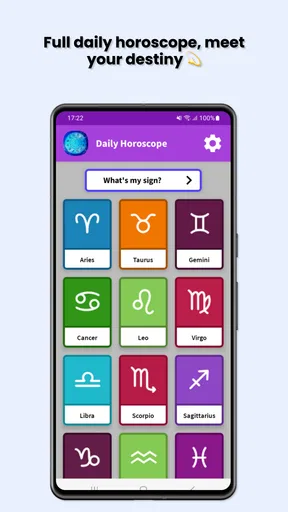
The app is intended to support all twelve Western zodiac signs: Aries, Taurus, Gemini, Cancer, Leo, Virgo, Libra, Scorpio, Sagittarius, Capricorn, Aquarius, and Pisces. You generally choose your sign during setup or from the main menu, then receive content tailored to it. If you are unsure of your sign, the app may help you identify it using your birth date.
Does Daily Horoscope 2026 require an internet connection?
Some parts of Daily Horoscope 2026 may work after the app has loaded or saved content, but an internet connection is commonly needed to refresh daily predictions, display advertisements, download updates, or access additional features. Availability can depend on the app version and device. For the most reliable experience, open the app online at least once each day and keep it updated.
Is Daily Horoscope 2026 free to download and use?
Daily Horoscope 2026 may be available as a free download, although the exact features can vary between Android and iOS versions. Free access may include basic horoscope readings supported by advertisements, while premium options could remove ads or unlock extra content. Before downloading, check the store listing for current pricing, subscriptions, in-app purchases, and cancellation terms.
Can I rely on Daily Horoscope 2026 for important personal decisions?
You should not use Daily Horoscope 2026 as the sole basis for medical, financial, legal, relationship, or career decisions. Horoscope readings are general interpretations created for entertainment, inspiration, or self-reflection, and they are not scientifically verified predictions. Treat the app as a casual daily reading, then rely on qualified professionals, trustworthy information, and your own judgment for significant choices.
